It’s been almost a year since I launched PDF Ink to replace a battalion of WordPress e-commerce PDF watermarking plugins I’d built, and over ten years since I launched that battalion.
Because I, too, am noticing changes in the market (largely due to AI and unfortunate politics), I’d like to talk a little bit about challenges I’ve already overcome as an indie developer. That I’m female, and that I work independently definitely have played into challenges, but they definitely haven’t been the worst of it.
I’ve lurked Hacker News for about 7 years now, and have been keenly aware of every post where someone celebrates their first dollar on an indie software project. I smile to myself. I’ve been quietly succeeding that way a long time, without posting about it or acknowledging that I’m also succeeding. So, it’s time I congratulate myself, and also — call out some baloney. 🥪
Odd Reasons Indie Developers Like Me Face an Uphill Battle
Since 2003, I’ve participated as the WordPress ecosystem evolved from a hobbyist playground into a multibillion‑dollar marketplace. That growth brought opportunity, but it also created a stark power imbalance. Large players can leverage massive budgets to buy advertising, dominate search rankings, take down competition with legal threats, influence platform policies, and yet still — fail customers’ trust without consequence.
We assume that when we purchase the product with a corporate or big blog stamp-of-approval, it must be “better.” I assure you that is not the case, and urge you to research deeper.
As a developer who routinely looks under the curtain at plugin code, I am often shocked at what can pass as a WordPress plugin. It is no wonder so many people are angry at WordPress, and angry at WordPress developers. There is a lot of crap out there, and bound to be much more flooding in thanks to artificial intelligence (AI)!
I admit I occasionally also write crap (that’s a risk of any profession: making mistakes) but I also have consistently patched bugs within hours of reporting… for years. I understand the code I write, but sometimes fail to see edge cases. It’s funny to me that more and more we are seeing “developers” who do not understand their code at all.
Just like I’ve been shocked while auditing other developers’ code over the years (like the time I found a hacked radio station website running a Russian phishing scam for TEN YEARS!), I’ve been shocked by some of the other challenges two particular competitors have presented.
I’d like to finally talk about two of them.
1. Stolen Code Makes Unfair Competition
I remember where I was sitting 8 years ago when I discovered that one of my main competitors was using stolen code in order to deliver features I could not deliver (yet). This competitor was bundling a commercially licensed product in a GPL plugin. No way!
I felt very aggravated, and hamstrung.
WordPress.org offers a “free” downloadable content management system (CMS) product often used for blogging, but also good for e-commerce and any other type of website. WordPress is free in the sense that it doesn’t cost anything, but it’s also licensed GPL, which means it is open-source and free to distribute and adapt. You both “can” and cannot integrate non-GPL software in a GPL package. You especially CANNOT in the sense that the author of the commercial package, SetaSign, was being robbed of at least one sale on every sale of this competitor’s plugin.
So naturally I wrote an email to SetaSign, and a long-running alliance was formed. I knew that if I built a plugin to use SetaSign software (that’s PDF Ink) it couldn’t bundle the software, but it certainly could connect to the software if it was installed separately. That’s the direction I went, and I was glad to see the competition finally give up, years after they were asked to stop bundling the software in violation of license terms. They finally stopped selling their product because for some reason they couldn’t offer PHP 8.0 compatibility. Hm.
🤡 But really, in the meantime, how was I supposed to compete with that? People can cheat to get ahead, but dang — that’s upsetting to be reminded of!
2. A Takedown From a WordPress Sister Company
Again, I remember where I was sitting when I received an email from wordpress.org telling me I could no longer call my Woocommerce PDF watermarking plugin “WaterWoo” because it had the trademarked “woo” inside the name. 🙄 🥊
WooCommerce, based out of South Africa, does indeed own several trademarks. However, I wonder if that takedown would have happened if WooCommerce wasn’t also owned by WordPress’ owner: Automattic. This was around the time when news around Automattic started to grow ugly. The takedown felt abrupt and brusque, handled entirely inside wordpress.org communication channels. I obviously had no choice but to comply (or they’d remove me from the repository), which meant that although my plugin kept the slug (https://wordpress.org/plugins/waterwoo-pdf, which I cannot change), I renamed it WaterMark PDF for WooCommerce.
Here’s where it gets juicy. 🧃
WooCommerce, via WordPress employees/volunteers, let me know that it is okay for WooCommerce utility plugins to be called “Utility Plugin for WooCommerce,” but not “WooCommerce Utility Plugin” and definitly never “UtiliWoo” or “Wootility.” Woo never reached out on their own, and have never reached out to me directly. I’m not hard to reach, so I had to assume this was an internal WP sweep only.
So, yeah, I changed to WaterMark PDF for WooCommerce. Not too long after that, I noticed that WooCommerce PDF Watermark was now being called PDF Watermark for WooCommerce! ⚠️
That name confusion (WooCommerce using two names, flipped) potentially siphoned off freemium upgrades from my plugin, which was now named WaterMark PDF for WooCommerce at the time! People thinking they were upgrading from my free version were actually “upgrading” to the WooCommerce plugin. WooCommerce does not have a free version. So confusing. You can still see on their websites where they are using both names. Whether intentional or not, this is harmful to competition, given the amount of leverage this corporation has.
I decided to entirely rename to PDF Ink.
If you know anything about business and marketing, you’ll understand that having to change a product name twice in a couple years is devastating to business. This takedown happened right in the middle of the pandemic, making it seem even more cruel. Where does that get WooCommerce PDF Watermark? I’m not sure. It’s still the same plugin it was five years ago; no new features, unfulfilled (technically impossible) promises.
I almost forgot to mention, as of Spring this year, WooCommerce PDF Watermark started using PDF Ink TCPDI/TCPDF forks in their code. Incredible. I guess I just have to laugh, and keep forking.
In this PDF watermarking plugin market, there is still confusion about who is who. I’ve now mentioned the two biggest competitors over the years. There are a couple of newer “small fry” on the market, generally types who spit out dozens of plugins, probably using artificial intelligence (AI) or dump trucks of caffeine.
For the average user, there is no way to tell if a plugin is crap until it breaks repeatedly and you cannot reach support, or maybe it doesn’t break but it’s silently a security risk. I feel sad that so many potential customers of mine have fallen into these traps over the years, and understand on many levels why WordPress can become villainized. All that said, I still love WordPress as a code base, and its fun community.
Hopefully I can continue to stand out as the scrappy indie coder who has consistently worked hard, played fair, and satisfied customers. I work to improve PDF Ink every day of the week, to the point where there is absolutely NO comparison between PDF Ink and other “similar” plugins.
What Sets PDF Ink Apart
Affordability Without Compromise
PDF Ink is priced dramatically lower (licenses starting at $45) than the corporate alternatives, yet it delivers all the core features plus a plethora of extras. It is also very extensible and well-supported. Customers just get more bang for their buck. Frankly, at this point 10+ years down the road, the competition is imitative.
Super‑Fast & Friendly Customer Service
Every support ticket receives personal responses—usually within 24 hours, and most often within 8 hours. For years now, every bug has been fixed the same day it was reported. For many users, that level of attentiveness is the decisive factor when choosing a tool they’ll rely on daily.
Transparency & Ethical Development
All code is GPL licensed, documented, and auditable. PDF Ink is NOT vibe-coded, NOT stolen, and slavery-free (unless of course you count me). I pride myself on doing the right thing, and all my customers are happy (even if it means providing a refund).
Resilience Through Community
Because I’m an indie developer, I must stay close to the community that uses my plugin. Feedback loops are tight, feature roadmaps are shaped by real user needs. Nearly every feature update feels like a collaboration.
Queen of Perseverance
These experiences have reinforced my belief that small‑biz perseverance isn’t just a survival tactic—it’s a competitive advantage. The very obstacles larger companies create become proof points for why independent developers can—and should—outperform them.
Facing competitors that “cheat” with stolen code and wield legal muscle has been discouraging, but it also highlights what matters:
- Customers first: When users know they’ll get a human on the other end of an email, they stay loyal—even if a bigger name tries to poach them.
- Integrity: Building on legitimate, GPL‑compatible libraries and giving credit where it is due ensures that the ecosystem stays healthy for everyone. Fair competition is a thing.
- Adaptability: A forced name change was an opportunity to clarify my brand story. In fact, every forced change in software is an opportunity.
The open‑source world thrives because people like us choose honesty, skill, efficiency, and genuine care over shortcuts and intimidation. I’m proud that through all this I just kept grinding. I wish I didn’t take the hits because they have definitely hurt, but I will KEEP GRINDING. And boy, can I grind.
Your support—whether it’s the purchase of PDF Ink, five‑star review, or a referral—fuels that perseverance. Together we prove that a passionate indie developer can deliver a superior WordPress plugin.
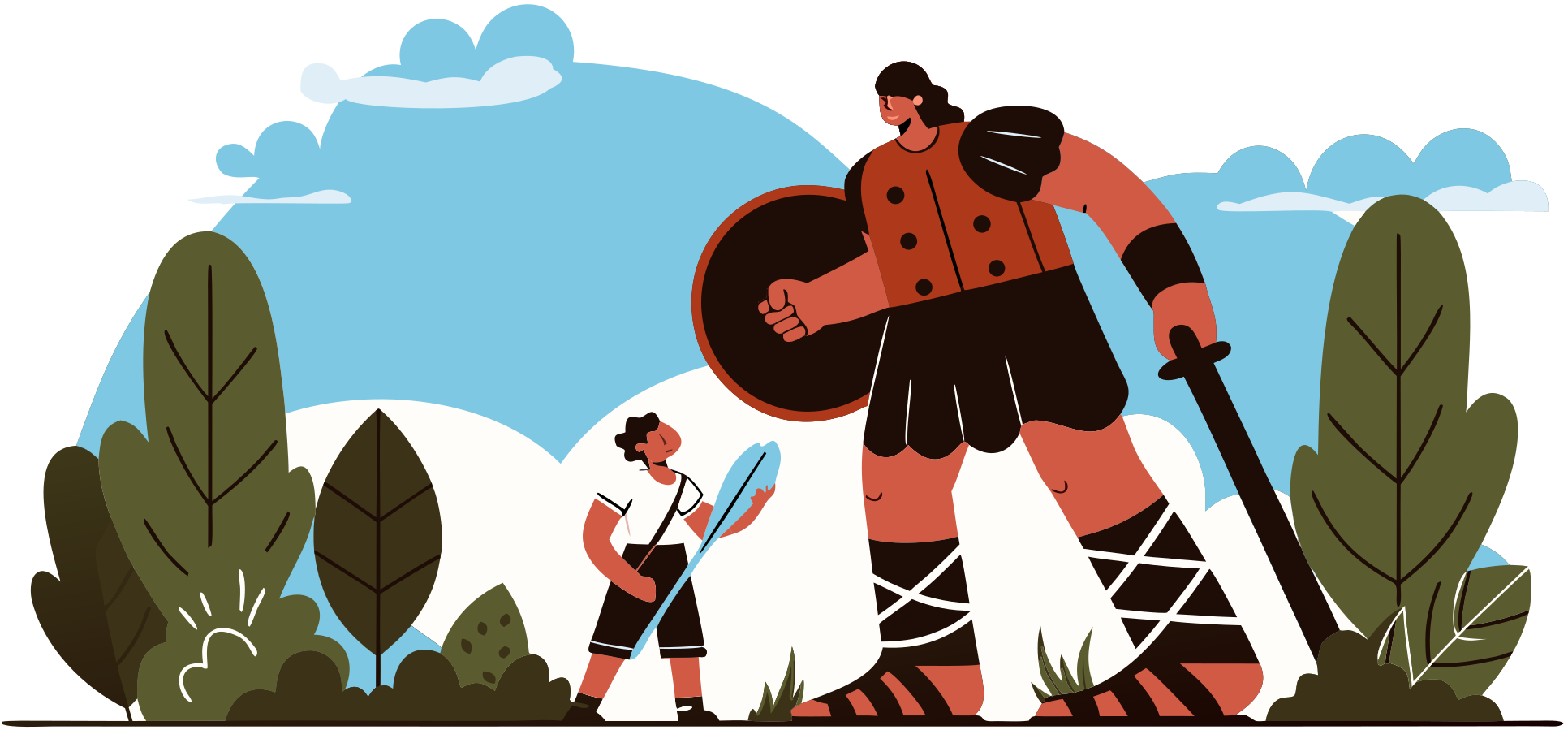
Thank you for believing in the power of the little guy (or in this case, gal).
Ed Hirschman
Fascinating story of perseverance. Keep up the good work!